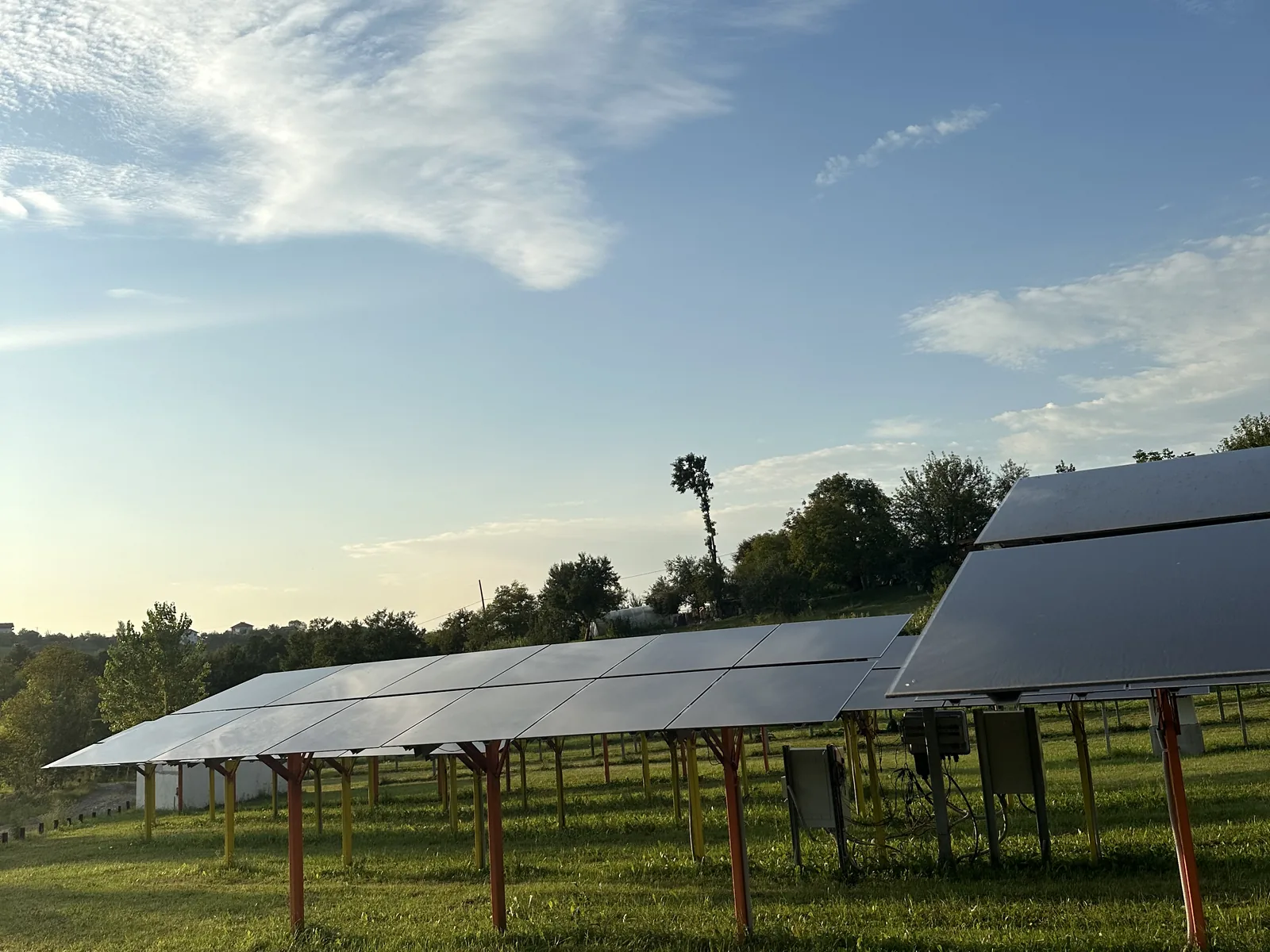
Rows of solar panels at the Comex plant at Raduša in daylight

    Negative-price protection for solar plants

    Stop paying to export.

    When the day-ahead price for a fifteen-minute slot drops below your floor, every exported kilowatt-hour costs you money. A controller at your plant reads the price for every slot and tells the inverters to stop exporting for exactly those slots, over Modbus or a shutdown signal, then lets them run again the moment the price recovers. No battery, no decision travelling over the internet, no one driving to site.

    What is running today

    control decisions per plant, per day
    96control decisions per plant, per dayComex fleet, September 2026
    PV plants running it
    3PV plants running itComex fleet, September 2026
    price resolution, matching the exchanges
    15 minprice resolution, matching the exchangesSEEPEX, CROPEX and HUPX day-ahead
    batteries required
    0batteries requiredIt works on the inverters you already have

    The problem, in numbers

    Negative prices reached this region in 2026.

    For years this was a German and a Spanish story. SEEPEX permitted negative prices in May 2026 and printed nine consecutive negative hours a month later. Every plant that exported through those hours paid for the privilege.

    consecutive negative-price hours on SEEPEX for delivery on 7 June 2026, one month after negative prices were permitted
    9consecutive negative-price hours on SEEPEX for delivery on 7 June 2026, one month after negative prices were permittedBalkan Green Energy News, 8 June 2026
    negative-price hours in Greece in Q1 2026, up from zero a year earlier
    138negative-price hours in Greece in Q1 2026, up from zero a year earlierENTSO-E Transparency data, via pv magazine, May 2026
    negative-price hours in Bulgaria in the first seven months of 2026
    166negative-price hours in Bulgaria in the first seven months of 2026Capalo AI, 2026
    negative-price hours across the EU-27 in Q1 2026, against 593 a year earlier
    1,223negative-price hours across the EU-27 in Q1 2026, against 593 a year earlierENTSO-E Transparency data, via pv magazine, May 2026

    A plant that shuts down through those hours, and only through them, keeps the rest of the day intact. The decision is worth making every fifteen minutes, which is more often than anyone will do it by hand.

    How it works

    Price in, decision out.

    1. Read the price

      The controller fetches the day-ahead price for the coming fifteen-minute slot from the exchange your plant sells into.

    2. Apply your rule

      It compares the price against a floor you set. The default sits a few euros above zero, so the plant never exports for less than it costs to do so.

    3. Tell the inverters

      Where the inverters accept it, the controller writes an active-power limit to each one over Modbus, so the plant keeps producing for self-consumption. Where they do not, a digital output signals the inverter to stop. When the price recovers, export resumes on its own.

    It keeps working when we are offline

    The rule runs on hardware at the plant, not on our servers. If the price feed is unreachable, the controller holds its last decision and does not guess; it never leaves the plant in an undefined state, and it never needs anyone awake on our side.

    Cross-border plants are quoted individually

    A plant that exports across a border has a second price to weigh, the cost of the corridor it uses. We run that comparison at one plant today and explain it on the call rather than on this page.

    What you get

    A small box, and the service behind it.

    On site

    • An industrial router and controller on a DIN rail, with cellular failover
    • A Modbus link to the inverters, or a digital-output line to each inverter's shutdown input
    • Commissioning and a functional test with you present

    Ongoing

    • The day-ahead price feed for your market
    • The export rule maintained as market rules change
    • Monitoring, with an alert when the controller stops reporting
    • A monthly report of slots curtailed and estimated saving
    • Remote support

    Pricing

    Three configurations. One quote, from your inverter list.

    Nobody in this market publishes pricing. We publish the shape of it and quote the figure from your inverter list and single-line diagram, so you know before the first call whether this is a small engagement or a project.

    Shutdown signal

    Inverters without a usable Modbus register; the controller signals them to stop

    Indicative pricing on request

    • Controller and digital outputs
    • Commissioning visit
    • Monitoring and the monthly report

    Active-power limit

    Inverters we can set individually over Modbus

    Indicative pricing on request

    • Controller and Modbus links
    • Per-inverter export limits
    • Commissioning visit
    • Monitoring and the monthly report

    Portfolio

    Several plants under one owner

    Indicative pricing on request

    • Everything in Active-power limit, per plant
    • One report across the portfolio
    • Priority support

    Quotes state VAT separately and say plainly what is hardware and what is service. Cross-border plants and inverter families we have not yet integrated are quoted individually.

    Is it for your plant?

    Good fit, poor fit.

    A good fit

    • A grid-exporting PV plant of any size
    • Inverters with a Modbus interface or a digital shutdown input
    • Sale into a market with day-ahead pricing: SEEPEX, CROPEX, HUPX or another
    • Exposure to the price, directly or through your offtake contract

    A poor fit

    • A plant with no export at all
    • A fixed-price offtake that removes your price exposure entirely
    • Inverters with neither a Modbus interface nor a digital input

    Active-power control over Modbus is proven on INVT inverters through Solarman loggers. Other inverter families need a register check first; the shutdown signal works on any inverter that has an input for it.

    What we run today and what we do not yet, stated plainly

    Start here

    Two problems we solve. Pick yours.

    Negative-price curtailment

    Stop exporting when the day-ahead price goes to zero or below. No battery required.

    You are here

    BESS integration and optimisation

    The control layer between the market and your battery plant, supplied with the hardware and the commissioning.

    Before you ask

    Does it need a battery?
    No. It acts on the inverters you already have. A battery changes the question from “when to stop exporting” to “when to store and when to sell”, and that is a different page.
    Which inverters work?
    Active-power control over Modbus is proven on INVT inverters reached through Solarman loggers. For other families we check the register map before quoting, and if a clean Modbus path is not there, the shutdown signal still applies.
    What happens when the connection drops?
    The controller holds its last decision until the price feed is back. It does not stop the inverters because a connection was lost, and it does not export on a guess. You are told when a plant goes quiet.
    I sell under a contract. Do negative prices reach me?
    Only if the contract passes the market price through, which most merchant and trader contracts do. Send us the pricing clause with the production data and we will tell you whether there is anything to protect.
    How long does installation take?
    Weeks, not months. One site visit for the controller and the wiring, a functional test with you present, and the rule is live.
    Can I see it running?
    The three curtailment plants belong to clients and are not public. Our own plant at Raduša is public and shows the same price feed driving a battery; we show anonymised curtailment logs from client plants on request.

    Already have a battery, or planning one? The storage page is here

    The lowest-friction thing we offer

    Send twelve months of production data.

    Tell us the market you sell into and share your production history. We will tell you what curtailment would have saved you last year, and what it costs to run this year. No site visit is needed to answer that.

    See our own plant running on the same price feed

    We use this only to prepare your answer. No newsletter, no resale.